

Why Imagine Aliens?
When we imagine extraterrestrial life, we often draw on familiar images: little green men, humanoid creatures, or monsters inspired by science fiction. But what might life look like if it evolved under conditions radically different from those on Earth?
Advances in astronomy and exoplanet research have transformed our understanding of planetary diversity. Thousands of planets have been discovered beyond our solar system, revealing an extraordinary range of environments. Some worlds are tidally locked, others experience extreme temperatures or atmospheric conditions, while rogue planets drift through space without orbiting a star. Astrobiology invites us to consider how life might emerge and adapt in environments unlike our own.
Imagining alien life is therefore more than an exercise in science fiction. It is an opportunity to question our assumptions about biology, habitability, and what it means to be alive. It also offers a way to explore how scientific knowledge and artistic imagination can work together to generate new ideas.
These questions form the foundation of Imagine Aliens, a research project investigating how the integration of art and science can support creative inquiry, scientific engagement, and transdisciplinary learning.
Publications
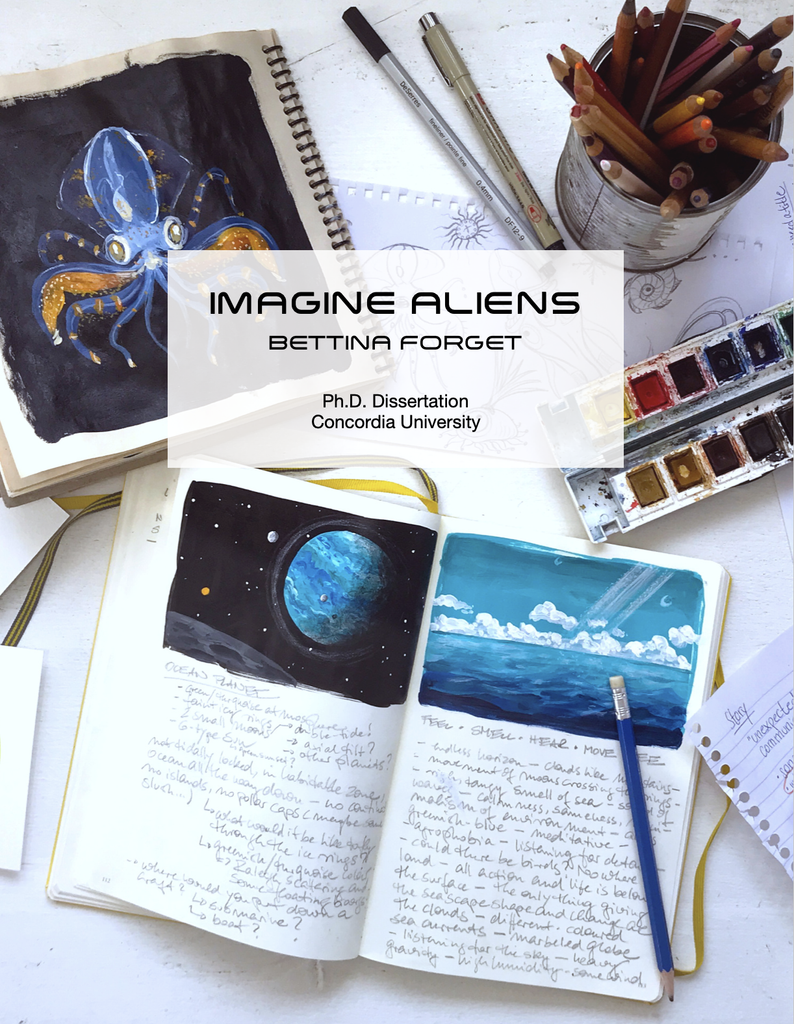
Doctoral Dissertation
Forget, B. (2026). Imagine Aliens [Doctoral dissertation, Concordia University].
The dissertation presents the theoretical framework, Design-Based Research methodology, classroom implementations, analysis, and findings of the Imagine Aliens study.
Canadian Art Teacher
Bettina Forget, Canadian Art Teacher.
An article introducing the Imagine Aliens project and its approach to integrating art, astronomy, and astrobiology in educational settings.
Read the article (PDF, page 48)
Leonardo Graduate Abstracts
Imagine Aliens — Leonardo Graduate Abstracts (2026)
The abstract of the Imagine Aliens doctoral dissertation was selected for inclusion in the Leonardo Graduate Abstracts database, which showcases graduate research at the intersections of art, science, and technology.
Research Questions
Developed as a doctoral research project in Art Education at Concordia University, Imagine Aliens investigated how artistic practices can be integrated with astronomy and astrobiology to create meaningful learning experiences.
The research explored three interconnected areas:
- Art-science integration: How can scientific knowledge become a creative resource rather than simply subject matter to be illustrated?
- Imagination and scientific understanding: How do scientific concepts influence the ways students imagine unfamiliar worlds and extraterrestrial life?
- Gender and participation: How might transdisciplinary approaches create more inclusive opportunities for students, particularly girls, to engage with science?
At the centre of the project is the idea that art and science are complementary ways of investigating the world, each contributing distinct methods of observation, interpretation, and knowledge creation.
Methodology: Research Through Creative Practice
The study employed Design-Based Research (DBR), an iterative methodology that brings educational research into real-world learning environments.
Working with students aged 6 to 13 in three Montreal schools, the research developed and refined a series of art-science activities inspired by exoplanets and astrobiology. Successive cycles of curriculum design, classroom implementation, observation, and analysis informed the evolution of the project.
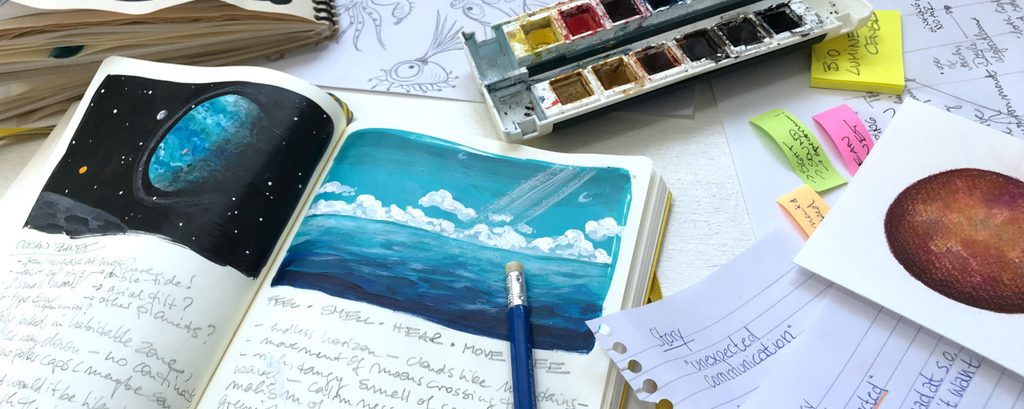
A central component was a collection of creative prompt cards that introduced scientific concepts and speculative possibilities. Students used these cards, together with the Imagine Aliens website, to investigate planetary environments, imagine extraterrestrial organisms, and develop narratives about life beyond Earth.
The activities included planetary paintings, illustrated Explorer’s Journals, paper-cut stop-motion animations, Crankie Theatre storytelling, and interactive science-fiction narratives created with Twine.
Rather than asking students to reproduce established scientific imagery, the activities encouraged them to interpret scientific information through artistic experimentation. The resulting artworks, stories, classroom conversations, and research documentation provided insights into how students negotiated the boundaries between artistic and scientific inquiry.
Key Research Findings
Science as an Enabling Constraint for Creativity
Scientific knowledge does not necessarily limit imagination. In Imagine Aliens, information about planetary environments, gravity, atmospheric conditions, and biological adaptation provided enabling constraints that encouraged students to move beyond familiar science-fiction conventions.
Students who engaged with the scientific prompts frequently developed more distinctive and scientifically informed representations of alien life. Their artworks and stories reflected imaginative responses to unfamiliar environments rather than reproductions of familiar extraterrestrial stereotypes.
The cards and website functioned as generative tools, providing enough structure to orient inquiry without prescribing creative outcomes. Scientific knowledge expanded the possibilities for artistic exploration, while creative experimentation encouraged students to investigate scientific concepts more deeply.
This reciprocal relationship challenges approaches to STEAM education in which art serves primarily to illustrate or decorate scientific content. Instead, Imagine Aliens positions art and science as co-equal partners in the production of knowledge.
Art as a Site for Scientific Learning
Scientific understanding was evident throughout the students’ artworks, stories, and creative processes. Their representations of imaginary planets and organisms demonstrated how they interpreted and applied concepts from astronomy and astrobiology.
At times, scientific inconsistencies became productive opportunities for discussion. Rather than treating these moments as failures, students were encouraged to question their assumptions, explore alternatives, and refine their ideas.
Artistic activities created a learning environment in which scientific inquiry could unfold through experimentation, dialogue, and creative problem-solving, without the immediate pressure of conventional testing.
An important finding was that students did not always recognize their artistic investigations as science learning, even when their work demonstrated substantial engagement with scientific concepts.
This suggests that artworks and creative processes can provide valuable evidence of scientific understanding, complementing traditional methods of assessment and opening alternative pathways into STEM education.
Pink Resistance: Gendered Aesthetics and STEM Engagement
The research revealed distinct gendered patterns in students’ artistic choices, including preferred motifs, media, and colour palettes. However, these differences did not correspond to differences in their engagement with scientific content.
Girls who incorporated traditionally feminine aesthetics, including pink colours and decorative motifs, demonstrated scientific understanding and engagement comparable to that of their male peers. All-girl teams were just as likely as all-boy teams to integrate scientific concepts into their imaginary worlds and life forms.
Rather than interpreting girl-coded aesthetics as evidence of limited interest in science, the research suggests that these forms of expression can provide meaningful entry points into STEM.
The concept of pink resistance describes how girls used culturally familiar aesthetic codes to claim space within a field often associated with masculine imagery and identities. By imagining pink planets, colourful organisms, and unconventional alien environments, they challenged assumptions about what scientific engagement should look like.
These findings suggest that inclusive STEM education need not require students to abandon their preferred forms of expression. Instead, recognizing and accommodating diverse aesthetic identities can help create more welcoming opportunities for scientific inquiry.
Subject Inertia: The Challenges of Transdisciplinary Learning
While Imagine Aliens successfully integrated artistic and scientific activities, the research also revealed how strongly conventional school structures reinforce disciplinary boundaries.
Students frequently compartmentalized their learning according to the expectations of different classrooms. Scientific ideas developed in one setting did not always carry over into artistic or literary activities in another.
The study describes these phenomena as subject inertia and classroom stickiness: the tendency for disciplinary expectations and learning environments to shape how students understand and transfer knowledge.
Classrooms are not neutral spaces. Their physical arrangements, materials, routines, and cultures communicate expectations about what counts as learning. Moving between a science classroom and an art studio can therefore involve more than a change of location; it can also mean a shift in how students approach knowledge and creative work.
The Imagine Aliens cards, website, and Explorer’s Journals helped bridge these boundaries by providing shared reference points across disciplines. These materials functioned as boundary objects, allowing students to carry ideas between learning environments.
The findings suggest that effective transdisciplinary education requires not only integrated subject matter but also deliberate attention to learning spaces, teaching practices, and institutional structures.
Popular Culture, Collaboration, and Creative Inquiry
Popular culture played a significant role in shaping students’ ideas about extraterrestrial life. Science-fiction films, games, fantasy stories, and familiar alien stereotypes provided a shared visual vocabulary that influenced their initial concepts.
Rather than dismissing these influences, Imagine Aliens used them as starting points for critical inquiry. Comparing fictional representations with scientific information encouraged students to question familiar assumptions and develop alternative possibilities.
The study also revealed important distinctions between collaborative and individual learning. Students benefited from working together during scientific research, discussion, and brainstorming, but individual artistic activities often provided greater freedom for experimentation and personal expression.
These findings suggest that transdisciplinary education benefits from a flexible balance between collaboration and individual creative practice, allowing students to develop shared knowledge while maintaining their distinct artistic identities.
Implications for Art-Science Education
The Imagine Aliens study demonstrates how integrating artistic practice with scientific inquiry can create meaningful opportunities for learning across disciplinary boundaries.
Its findings suggest that science can expand creative possibilities, that artistic expression can make scientific understanding visible, and that students’ diverse cultural and aesthetic identities can enrich their engagement with STEM.
At the same time, the research highlights the challenges of transdisciplinary teaching. Classroom environments, disciplinary expectations, and institutional structures influence how students connect and transfer knowledge.
By bringing these factors into focus, Imagine Aliens contributes to ongoing discussions about STEAM education, gender inclusion, and the development of pedagogical approaches that treat art and science as interconnected forms of inquiry.
Beyond the Dissertation
Although the doctoral study was completed in 2026, Imagine Aliens continues to evolve through educational workshops, exhibitions, public engagement, and the development of creative resources.
The project’s methodology has been adapted for different audiences and learning environments, including public programming at the Exploratorium in San Francisco.
As an ongoing art-science initiative, Imagine Aliens continues to explore how creative practice can encourage curiosity about the universe, challenge anthropocentric assumptions, and open new possibilities for learning and imagining life beyond Earth.